

Jewelry made of brass or stainless steel?
Jul
One of the most frequently asked questions among customers choosing jewellery is whether they should opt for brass or stainless steel.
The truth is that both materials are widely used in jewellery making today. However, each has its own distinct characteristics and serves different needs in terms of design, production and aesthetics.
Stainless Steel in Jewellery Making
Stainless steel is primarily used in larger-scale and mass jewellery production.
As a material, it is particularly hard, which significantly affects how jewellery can be designed and manufactured. For this reason, it is often used for simpler, cleaner designs that can be produced easily in large quantities.
Stainless steel jewellery is typically:
- produced in large quantities,
- influenced by current fashion trends,
- and aimed primarily at a more affordable market segment.
At the same time, the quality of stainless steel can vary considerably from one manufacturer to another. Therefore, not all stainless steel jewellery necessarily offers the same level of durability or retains its original shine over time.
Why Brass Is Often Used in Handmade Jewellery
Brass is a metal that has been used in handmade jewellery making for centuries.
One of its key properties is its malleability. It can be shaped relatively easily, allowing for greater creative freedom and offering more possibilities when producing distinctive and intricate jewellery designs.
Brass is often used in handmade jewellery because it:
- supports small and flexible production runs,
- allows for more complex and distinctive designs,
- conforms more comfortably to the body due to its flexibility,
- and can be repaired or modified more easily when necessary.
Furthermore, due to the high cost of gold and silver, brass is often used as the base metal for larger or more striking pieces. It offers an ideal balance between aesthetics, quality and the overall weight of the jewellery.
The Importance of High-Quality Plating
The durability of a piece of jewellery depends not only on the base metal, but also on the quality of its plating and its overall craftsmanship.
A properly plated piece of brass jewellery can offer excellent long-term durability, retaining its shine and aesthetic appeal for an extended period.
Conversely, a low-quality piece of jewellery may deteriorate relatively quickly, regardless of the material from which it is made.
For this reason, manufacturing quality and the expertise of the workshop play a decisive role in the final result.
Which Material Is Ultimately Better?
There is no single definitive answer, as the right choice depends on the type of jewellery, the desired style and the production method.
Stainless steel is often used for larger-scale, more affordable production, while brass is particularly valued in handmade jewellery that places emphasis on:
- design,
- attention to detail,
- uniqueness,
- and flexibility in the manufacturing process.
Handmade Brass Jewellery with Exceptional Attention to Detail
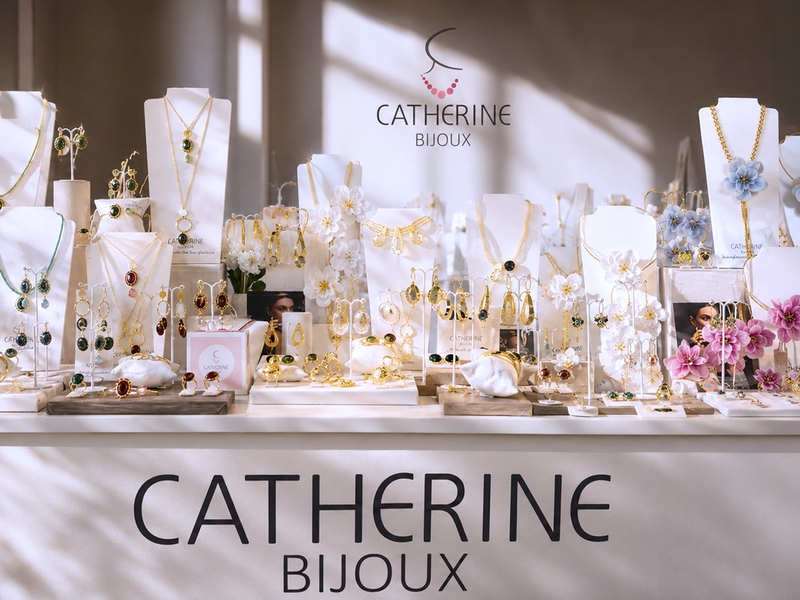
At Catherine Bijoux, we have been designing and creating Greek handmade brass jewellery for more than 35 years.
Our collections are created to combine:
- distinctive design, with a strong emphasis on comfortable wear and high-quality materials,
- a unique aesthetic that harmoniously blends minimalism with more striking and elegant elements.
Brass’s ability to support more fluid forms and intricate details is one of the main reasons it remains one of the most important materials in handmade jewellery today. It is also why brass continues to be the primary metal used throughout the Catherine Bijoux collections.
Discover one of the Catherine Bijoux metal collections featuring distinctive textures: Andromeda’s Galaxy Collection.